
The Tower Tarot Card: Reversed, Feelings, Love, Yes or No
The Tower is the card of sudden change. Something that looked solid turns out to stand on a weak foundation, and it comes down fast. It is one of the most feared cards in the deck, yet its core message is “a truth you can no longer avoid.” Upright, the shake-up is already happening. Reversed, you can feel it coming and are trying to hold it off.
Below you will find the upright and reversed meanings, what The Tower says about feelings, love, work and money, how to read it as a yes-or-no answer, and a worked example of the card inside a three-card reading.
The Tower at a glance
| Arcana | Major Arcana, card XVI |
| Upright keywords | upheaval, revelation, sudden change, awakening |
| Reversed keywords | fear of change, delayed upheaval, a narrow escape |
| Yes or no | No, or “not the way you planned” |
| As advice | Stop propping up what is already cracking |
What the card shows
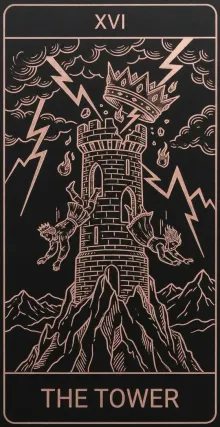
On the Ascendra card, a stone tower stands on a jagged mountain peak under a storm. Lightning hits the top, the crown that sat on the battlements is thrown into the air, and two figures fall headfirst, one of them still wearing a small crown. Fire drops from the sky.
Three details carry most of the meaning. The lightning comes from outside: the change is not something you scheduled. The crown stands for pride, status or a belief you were sure of, and it is the first thing to go. The falling figures are not being punished; they are being shaken out of a structure that was never as safe as it looked.
The Tower upright
Upright, The Tower describes a moment when the ground shifts all at once. A secret comes out. A job, a plan or a relationship you were counting on changes shape overnight. A belief you held about yourself or someone else stops making sense.
What makes this card different from the other “hard” cards is speed and clarity. The changes are abrupt, but they are also honest: after the lightning, you can see what was really there. That is why many readers call The Tower a card of revelation as much as destruction.
In practice, the upright Tower asks you to stop spending energy on keeping up appearances. If something is coming down, the useful question is not “how do I stop this?” but “what was this built on, and what do I want to build instead?”
The Tower reversed
Reversed, the upheaval has not fully arrived, or it is being held back. There are two common readings, and the rest of the spread usually tells you which one fits:
- Delayed change. You can see the cracks, and so can the people around you, but everyone is acting as if nothing is wrong. The pressure keeps building. The reversed Tower suggests that waiting will not make the eventual change smaller, only later.
- A narrow escape. A crisis was close and did not happen, or happened in a smaller way than it could have. This is a chance to fix the foundation before the next storm, not a sign that the problem is gone.
Some readers also see the reversed Tower as an internal shake-up: the change is happening in how you think, quietly, rather than in your circumstances.
The Tower as feelings
People often draw The Tower when they ask how someone feels about them. It rarely describes calm or lukewarm feelings.
- Upright as feelings: intense, unsettled, sometimes overwhelming. The person may have had a sudden realisation about you or about the relationship. It can be attraction that hit them out of nowhere, or the moment they saw something they could not unsee. It does not automatically mean they dislike you; it means their feelings are not stable right now.
- Reversed as feelings: they feel the pressure but are trying to keep things as they are. They may be avoiding a hard conversation, holding back a confession, or pretending a problem is smaller than it is.
- After a breakup: the upright Tower often points to shock. The ending felt sudden to them, even if the warning signs were there. Reversed, they are still resisting the fact that it is over.
The Tower in love and relationships
In a relationship, upright Tower points to a sharp turn: an argument that finally says the real thing, a secret coming to light, or a change in circumstances (a move, a job, a family event) that tests the relationship. Couples can come through a Tower moment stronger, but only if they deal with what it reveals.
If you are single, it can mean a sudden attraction that throws you off balance, or the end of an old pattern in how you choose partners.
Reversed in love, it is the argument everyone is avoiding. Both people can see the problem, nobody names it, and the tension leaks out in other ways.
About an ex, The Tower usually says the old version of the relationship cannot be rebuilt as it was. If you get back together, it would have to be on new ground.
The Tower at work and with money
At work, The Tower can mean a restructure, a sudden change in leadership, a project cancelled, or a role that ends unexpectedly. It can also be your own sudden realisation that you cannot stay in a job any longer.
With money, it is a warning against plans that depend on everything going right. Upright, it can point to an unexpected expense. Reversed, it suggests you can still shore up a weak spot before it costs you: savings, a contract, a backup plan.
None of this is financial advice. Treat the card as a prompt to check what you are relying on, not as a forecast.
Is The Tower a yes or no card?
As a yes-or-no answer, The Tower is a no, or at least “not the way you are imagining it.” If your question is “Will this go smoothly?” the answer is clearly no. If it is “Will the truth come out?” or “Will things change?” the Tower leans yes, quickly.
Reversed, read it as not yet: the change you are asking about is being delayed, by you or by circumstances.
For the full table of all 78 cards and how to phrase a yes-or-no question, see Yes or no tarot: every card’s answer.
The Tower as advice
When The Tower shows up in an advice position, it is telling you to stop propping up something that is already cracking. That might be a story you keep telling yourself, a role you have outgrown, or a plan that only works if nothing goes wrong. Let it go on your terms before it goes on its own.
Example reading: The Tower in a three-card spread
The Ascendra app uses a three-card spread: past (what shaped the situation), present (where you are now) and future (what lies ahead if nothing changes). Here is how The Tower can read inside it.
Question: “Why does my relationship keep feeling unstable?”
Past: Four of Pentacles. Holding on tight. Security mattered most, and change felt like a threat.
Present: The Tower. The tight grip is not working any more. Something has come into the open, or is about to, and the old way of keeping things steady is breaking down.
Future: The Star. After the shake-up, a calmer and more honest version of things. Hope that does not depend on control.
Read together, the cards tell a story: the instability is not random. It comes from trying to keep everything fixed, and The Tower is the point where that stops working. The Star in the future position does not promise the relationship survives in its current form; it promises that the person asking will feel clearer and lighter afterwards.
Notice how The Tower changes with position. In the past it would describe a shock you are still recovering from. In the present it is happening now. In the future it is a warning: something in the current setup will not hold, and you still have time to change it.
The Tower with other cards
- The Tower and Death: a major ending and a real transformation. Not a small adjustment; a chapter closing.
- The Tower and The Star: rebuilding after a crisis. The hard part comes first, the healing after.
- The Tower and the Three of Swords: a painful truth in love, such as a betrayal discovered or words that cannot be taken back. See the Three of Swords.
- The Tower and The Lovers: a relationship or a choice is shaken up, and you find out what you really want.
- The Tower and the Wheel of Fortune: change that comes from outside, fast, and is not under your control.
Questions to ask yourself when The Tower appears
- What in my life am I holding together mostly out of habit or fear?
- What truth have I been avoiding, and what would happen if I said it out loud?
- If this situation fell apart tomorrow, what would I want to keep, and what would I be relieved to lose?
- What would I build if I were starting from scratch?
Tarot works best as a way to think a situation through, not as a prediction. If The Tower lands on a question that already scares you, take it as a nudge to look at what you can control, and talk it through with someone you trust.
Questions people ask
Is The Tower always a bad card?
No. It describes a sudden change, and sudden changes are uncomfortable, but the card is about something false or unstable coming down. Many readers see it as a relief in disguise, because what falls was not going to hold anyway.
Is The Tower a yes or a no?
Usually a no, or at least "not in the way you are picturing it." If you are asking whether a plan will go smoothly, The Tower says it will not. If you are asking whether the truth will come out, it leans yes.
What does The Tower mean as someone's feelings?
Upright, intense and unsettled feelings, often a sudden realisation about you or the relationship. Reversed, the person feels the pressure building but is trying to keep things the way they are.
What does The Tower reversed mean in love?
A shake-up that is being postponed. Problems are visible to both people, but nobody is saying them out loud yet. It can also mean a breakup or crisis that was narrowly avoided.
Ask your own question
In the Ascendra app you type a question, draw the cards and get a written reading. Your first 2 readings are free, and so are the Daily Card and the daily horoscope. More readings come with Ascendra Plus, a paid subscription.
Get it on Google PlayAndroidAscendra is Android-only for now; there is no iPhone version yet. Everything on this page is free to read.
Tarot and dream interpretation on this site are for entertainment and self-reflection. They are not medical, psychological, legal or financial advice. Readings in the Ascendra app are generated by AI. Full disclaimer